
Sign up today and enjoy 3 months free with our special welcome offer!


What is an eSignature? How It Works, Its Benefits, and Are They Legal?
January 29, 2026 | Posted By Autor
Posted By: Admin
About esiganture software online
The way organizations approve and execute documents has undergone a dramatic transformation over the past few years. Paper-based signing procedures, once considered the hallmark of professionalism and legal authenticity, are gradually being replaced by faster, more secure electronic alternatives.
Today, organizations of all sizes use electronic signatures to efficiently complete agreements.
This article describes what an electronic signature is, how it works, the advantages it provides, and whether electronic signatures are legal.
It is written to help professionals and
decision-makers understand when and how to use an eSignature Online Free
tool or a more advanced enterprise solution.
What is an eSignature?
An eSignature, or an electronic signature, is a digital signature that indicates you have accepted or approved an electronic document. An eSignature is functionally the same as a signature on a paper document; however, it is applied and processed electronically.
An eSignature can take different forms, including signing one’s name, generating a signature on a computer screen, clicking on an acceptance button, or using cryptography to verify the identity of the signer.
It is not the visual representation of the signature that matters, but the fact that the party intended to sign the document and that this intention is associated with a particular document version.
It is for this reason that eSignatures online free
solutions are gaining widespread traction in contracts, agreements, forms,
and approvals.
How do eSignatures Work
The process of electronic signing is made easy for signers while remaining secure and traceable for the organization.
- First, the document is created or uploaded in electronic form. The sender then selects the people to be asked for their signatures and, if necessary, determines the order in which the signatures are to be obtained.
- The document is then sent electronically to the selected signers.The parties then examine the document and affix their electronic signatures through the tools available on the platform. This could be a simple verification process or an identity verification process, depending on the platform used.
- The document is then closed after the signing process. The platform then records data such as the time of signing, the identity details of the party signing, and the final form of the document. This is done through an audit trail, which serves as proof of execution.
- The
document is then stored safely and can be accessed at any time when
needed.
Types of Electronic Signatures
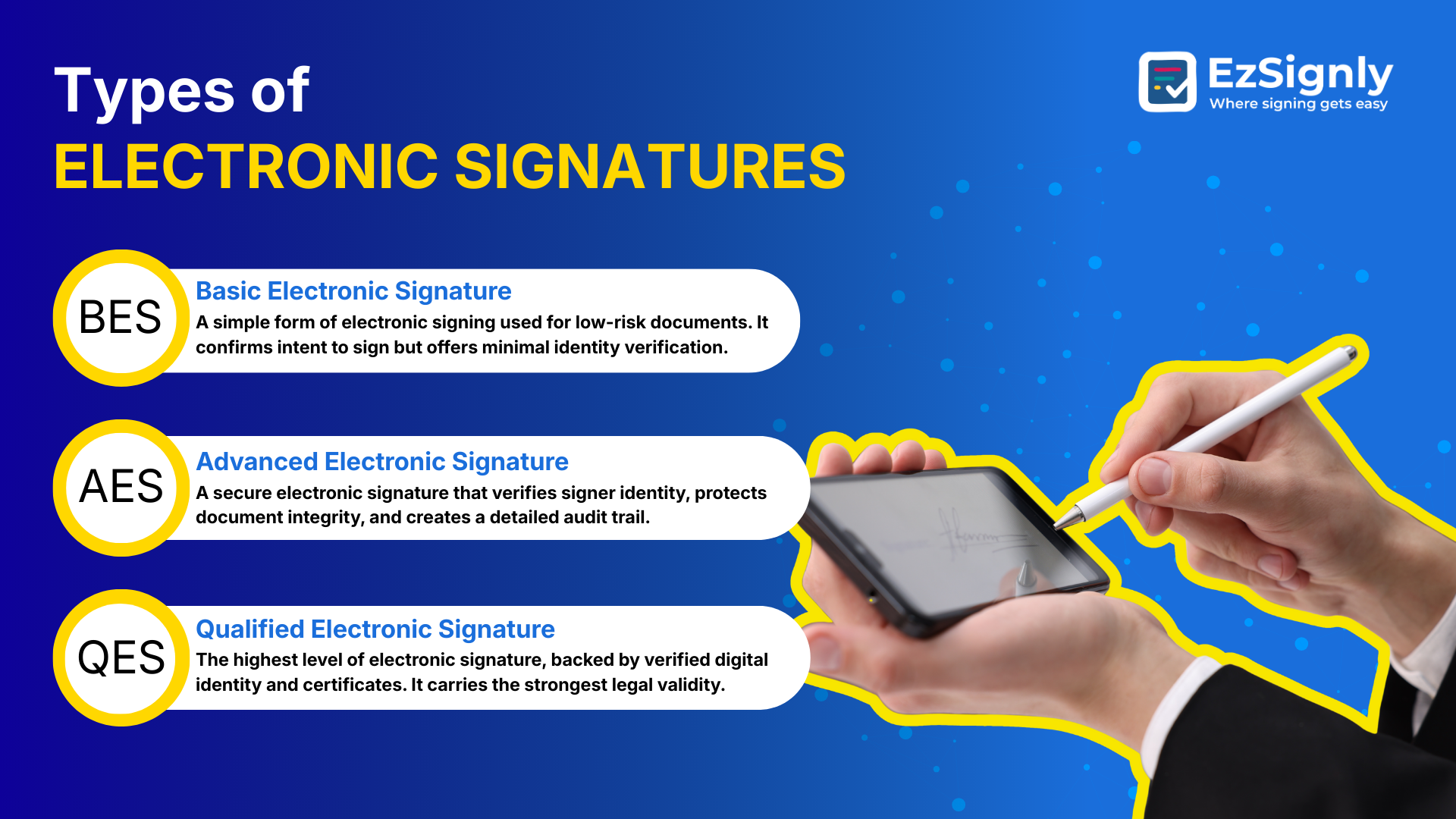
There are three types of electronic signatures, depending on the level of assurance they offer.
· Basic electronic signatures are used for low-risk documents. They involve little to no verification of identity.
· Advanced electronic signatures offer sophisticated features, such as verification of the party signing, tamper detection, and sophisticated audit trails. They are used for business transactions.
· Qualified electronic signatures have the highest level of assurance in some jurisdictions. They are founded on verified digital identities that meet stringent criteria.
The type of document being signed determines which
electronic signature to use.
Types of eSignatures you should know
Are eSignatures Legal?
The use of electronic signatures is recognized as valid in most countries when certain conditions are satisfied. This includes the ESIGN Act in the United States, eIDAS in the European Union, and other electronic transaction acts in other countries.
In general, these acts validate that a signature cannot be considered invalid simply because it is an electronic signature.
So long as the intention to sign is clear, the party signing can be determined, and the document is not changed after signing, then an electronic signature is valid.
There may be certain documents that require special
treatment, such as notarization or physical signing, depending on the laws of
the country. However, for most business and employment contracts, electronic
signatures are valid.
How eSignatures Support Legal and Compliance Needs
Electronic signatures make it easier to comply with the law by ensuring that there is a verifiable record of signing. Each signed document includes an audit trail that records its sending, viewing, signing, and completion of the document.
Encryption and tamper-evident encryption are some of the security measures that protect the document after the signing process.
If any modifications are made to the document, the signature becomes invalid.
Due to these security features, many organizations use
an e-signature online free solution for legal documents to enhance audit
readiness and minimize the risk of disputes or non-compliance.
Benefits of Using Electronic Signatures
Electronic signatures deliver practical advantages across speed, cost, security, and accessibility, making them a core component of modern document workflows.
- Speed: The process of signing documents is faster, taking only minutes instead of days. This is especially true when the parties are in different locations.
- Cost savings: There is a reduction in costs associated with printing, paper, courier services, and storage.
- Security: Security is also improved. This is because digital signing platforms employ encryption, authentication, and audit trails to secure documents better than handwritten signatures.
- Accessibility: Document management becomes accessible to stakeholders. This is because documents can be signed from any internet-connected device.
- Standardization: Finally, electronic signatures promote consistency by standardizing workflows and reducing errors caused by manual processes.
EzSignly provides a multitude of benefits including
these, and more in their leading eSignature solution for businesses. Choose
the best plan for your needs, or try it for free!
How Businesses Use eSignatures
Companies across industries use electronic signatures for various admin and other purposes.
HR teams use electronic signatures for offer letters, employment contracts, and policy acceptance. The sales teams use digital signatures for completing customer agreements quickly. The legal teams use eSignatures for managing contracts, NDAs, and approvals.
The finance and procurement teams use digital signatures for vendor contracts and approvals.
These points show why companies choose a free online
eSignature solution for their business needs as part of their infrastructure.
eSignature Online Free Tool vs Paid Solutions
Many people and small organizations start with an eSignature Online Free tool to test digital signing capabilities.
Free solutions are helpful for simple requirements and low-volume document processing. Nevertheless, they might lack certain security, audit-trail, storage, or integration features.
Organizations may be able to find a paid solution as the number of documents increases or as compliance requirements for those documents increase. Paid solutions typically provide much greater security, more complex workflows, and the ability to retain evidence for longer periods than free solutions.
Therefore, whether you choose a free or paid solution
depends on the sensitivity of your document, the volume of your documents, and
your compliance risk.
Understanding eSignature Software Pricing
Subscription fees vary for most e-signatures based upon a number of factors such as the number of users, the number of documents signed, the security levels and the type of integration used.
Digital signatures are typically cheaper than paper-based signatures because electronic signatures require fewer administrative tasks than pen-and-paper signatures.
Service providers should be able to clearly
communicate how their eSignature software price aligns with their scalability
(e.g., number of employees) and provide transparency into what you're getting
for your money.
Security Considerations
Security is a crucial feature of eSigning solutions. Reliable industrial-strength eSigning services will provide encryption, limit access via permission-based controls, and maintain a comprehensive audit trail.
Businesses should evaluate eSignature tool for
legal documents based on how strong their compliance and security measures
are, to avoid complications with sensitive information.
When Should You Not Use an Electronic Signature?
Although electronic signatures are generally accepted, there are some situations in which they may not be suitable or valid.
- In some countries, there are specific documents that need to be signed in person or notarized. These documents can include wills, certain property transactions, court affidavits, or those involving powers of attorney. In such instances, electronic signatures may be limited or require additional validation.
- In some instances, electronic signatures may not be suitable if the identity verification standards cannot be met. If the identity of the signer cannot be verified, or if regulatory standards require in-person verification, then a traditional signing process may be required.
- Furthermore, companies that operate in tightly controlled areas of the industry should verify compliance policies prior to utilizing electronic signatures on any document which contains private or confidential information.
Although many modern systems provide extensive
security and audit capabilities there is also the possibility that corporate or
governmental regulations may place added limitations upon your ability to use
these tools.
Conclusion
A valid and secure way to sign documents electronically is through an electronic signature. The signature captures the signer's intent to sign the document, authenticates the signer's identity, and verifies that the document will remain intact using technical methods.
An eSignature Online free tool or complete
eSignature solutions for businesses have become essential to document
management.
Sign Smarter, Not Harder
As more companies transition from paper-based processes, electronic signature adoption is no longer a luxury but a necessity for many businesses. If you are ready to transform your document workflow, sign up on EzSignly today.
Take a look at the latest blog

December 31, 2025
Common E-Signature Mistakes (And How to Avoid Them)
An e-signature is a promise. But a simple mistake can make that promise legally worthless. I’ve seen businesses lose deals over errors that were easil...
October 30, 2025
DocuSign Alternatives 2025: Top 5 Best e-Signature Software Compared
Looking for an affordable DocuSign alternative in 2025? We evaluated top eSignature tools including EzSignly, Adobe Sign, PandaDoc to find which offer...
January 22, 2026
EzSignly: Electronic Signature Software to Sign Any Document with Confidence
electronic signatures matter today, how they transform everyday operations, and what makes modern eSignature adoption a smart business move rather tha...
January 27, 2026
From Paper to Digital: Why Businesses Choose EzSignly eSignatures
EzSignly eSignatures help businesses go digital, saving time, costs, and securely managing documents.
Have any other questions? EzSignly's team is here to help!
© 2026 Copyright EzSignly. All Rights Reserved